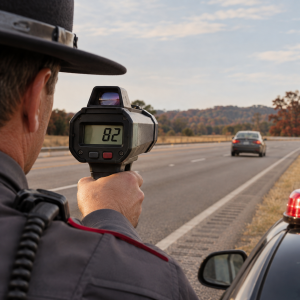
A cop with no radar gun is guessing.
He’s parked on the shoulder of the highway. A pickup with a rattling muffler roars past, and he’s sure it’s flying. A minute later a quiet gray sedan slides by. He barely looks up. Without radar, all he has is how fast each car sounds. So he pulls over the loud truck doing 68 and waves through the sedan doing 82.
That’s how a lot of agencies judge insurance producer performance.
The owner watches from the shoulder. One producer is always on the phone, always in early, always “working on a big one.” Another producer is quiet. When the new business numbers come in light, the owner reaches for the only explanation he can see from the side of the road. Motivation. “He just needs to want it more.”
I’ve heard some version of that line from agency owners more times than I can count. Most of the time, what that owner is missing is a radar gun.
The Radar Gun I Wrote About Years Ago
In Agency Growth Machine I used this exact picture. Without a radar gun, I wrote, it “would be difficult to tell how fast someone was going. All they could rely on is their feeling or opinion.”
Then I confessed to the argument every one of us has tried. “But officer, I set my cruise control on 72 miles an hour, so why are you pulling me over?” The officer says, “The radar clocked you at 82 miles an hour… and it doesn’t make mistakes. Here’s your ticket.” Case closed.
My point in the book was simple. If you can’t count and measure the activities that matter, you can’t create accountability. Without that, “it becomes a game of hearsay or opinions. And you already know; it will wear you out.”
Hearsay and opinions are exactly what most coaching conversations run on. The producer says the market is tough. The owner says he needs more hustle. Neither one can see the road.
Why You Blame the Driver
There’s a reason the owner lands on motivation. Every human brain explains other people this way, including yours and mine.
In 1967, two psychologists named Jones and Harris had people read essays about Fidel Castro. Readers were told the writers had been assigned which side to argue. They still decided the writers believed what they wrote. Ten years later, Lee Ross gave this a name: the fundamental attribution error. We over-credit a person’s character and under-credit the situation around them.
Researchers point to two reasons it happens. The person is what we see most when we look at them. And we usually lack detailed information about what actually caused their behavior.
Read that second reason again with your producers in mind.
You see the producer. You see him at his desk, in the sales meeting, in the parking lot at 5:15. What you can’t see is where his week broke. The voicemails that never turned into conversations. The conversations that never turned into appointments. The first meeting he walked into without doing his homework. When the details are missing, your brain fills the hole with character. Lazy. Comfortable. No fire.
So what? The fix you choose follows the diagnosis. Diagnose motivation and you buy a contest, a pep talk, or a speaker. Maybe you sit across from a producer you hired, and believed in, and tell him it’s over. The breakdown stays exactly where it was, and the next hire runs straight into it. That’s the real price of judging insurance producer performance from the shoulder.
Motivation is real. I’ve written about what actually motivates insurance producers, and you can influence it. You just can’t tell whether motivation is the problem until you can see the behavior.
The Question Most Owners Can’t Answer
Here’s a test. “Right now, without asking anyone, can you tell me what each of your producers did for prospecting activity yesterday?”
That’s one of the six questions on our Producer Success System Scorecard. It’s a hard one to answer honestly. If you’d have to ask, you’re coaching on self-reporting.
Self-reporting fails for an honest reason. Producers don’t always know where their own breakdown is. I learned that the hard way. In GRIT I admitted it: “I finally got productive when I kept track of my dials and conversations every day. Up until then, it was very easy to lie to myself about how hard I was working.”
Producers fool themselves first. I did. That’s why the radar has to be pointed at behavior and read by someone other than the driver.
The Behaviors That Separate Writers From Busy Producers
From the shoulder of the road, a producer who writes new business and a producer who just stays busy can look identical. Same hours. Same energy. Same full calendar. We’ve written about how busy producer activity hides a stuck producer in plain sight.
The difference shows up in a handful of behaviors you can actually see. Once you can see them, your coaching gets shorter and sharper.
They work a prospecting system that runs whether they feel like it or not. Defined target lists. Planned outreach. Follow-up that happens on schedule, good mood or bad. Measure whether the system ran for each named prospect.
They turn attempts into conversations, and conversations into appointments. At one of our Monday Mastermind sessions, Hunter on our team showed producers how to read the break point. Plenty of dials and no conversations points to the voicemail and email strategy. Plenty of conversations and no appointments points to the bold statement. The break point tells you which skill to coach. A pep talk fixes neither one.
They prepare before the meeting. You can see whether the homework on an account was done before the first meeting or after it. The coaching sentence that changes outcomes sounds like the example on our Scorecard results page: “I see you haven’t done pre-call prep on the Hartley account and your meeting is tomorrow. Let’s fix that right now.”
They ask for introductions and follow them through. The ask. The client saying yes. The prospect agreeing to meet. Each step is visible, so you know exactly where insurance producer introductions stall.
They track honestly. Hunter warned producers about checking every box on a sales call whether they got the answer or not. Fake data skews the percentages, and then everyone coaches to the wrong weakness. A radar gun that reads 55 for every car is worse than no radar at all.
Notice what’s missing from that list. Personality. Fire. Wanting it more. Every one of those behaviors can be seen, coached, and fixed.
Point the Radar at Coaching
A radar gun in the wrong hands turns into a speed trap. If producers believe measurement exists so you can write tickets, they’ll give you clean-looking numbers and keep their real week hidden. We’ve seen how producer autonomy decides whether a CRM gets used or quietly faked.
The point of the radar is the conversation it makes possible. “You’re having good conversations, and appointments aren’t getting set. Let’s work on your bold statement this week.” That’s a coaching sentence. It aims at a behavior, it’s specific, and the producer can do something about it by Friday.
Compare it with the conversation most owners have now. “How’s your pipeline looking? What’s holding you back?” The producer guesses. You guess back. Everybody leaves the meeting feeling worse, and nothing about insurance producer performance changes.
Here’s the part that should sting. While you’re pulling over the loud truck, the quiet sedan might be doing 82, and nobody in the building knows it. Or the loud truck might be the one with a broken part you could fix in a week, if you could see it. Either way, you’re making decisions about people’s careers based on engine noise.
Score Your Own Agency
Before you decide any producer has a motivation problem, find out whether you can see what they’re doing.
The Producer Success System Scorecard asks six questions about your agency’s system.
It takes about two minutes, and you answer it on your own. You see your results right away: a score out of 100, a letter grade, and which area to fix first (Onboarding and Workflow, Visibility and Coaching, or Methodology and Market).
If you’ve ever said “he just needs to want it more,” take the Producer Success System Scorecard and find out whether you’ve been judging insurance producer performance by engine noise.
P.S. If you’re an owner ready to talk now, book an Agency Diagnostic Call. It’s 30 minutes, and if we’re not a fit, we’ll tell you.